February 3, 2026 · 5 min read
Home EV charging in a Montreal winter: level 1 vs level 2
What cold does to level 1 and level 2 home EV charging, why the load calculation decides what your panel can take, and when to upgrade. Call (514) 909-3773.
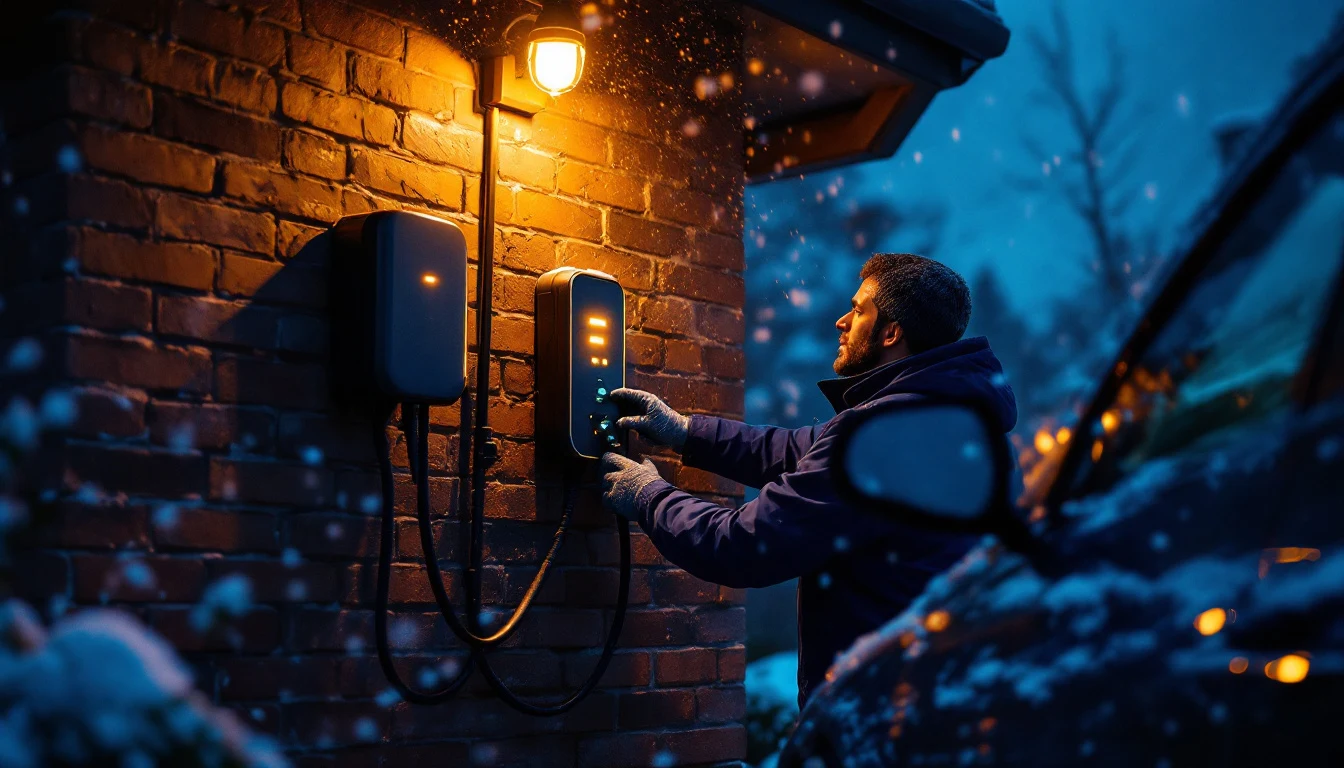
Your first electric winter in Montreal teaches you two things quickly. Cold cuts your range, and the charging cord that came in the trunk was never meant to be the whole plan. If your car sleeps outside, plugged into a regular outlet, and the battery gauge has barely moved by morning, nothing is broken. That is what level 1 charging looks like at minus twenty. Here is what is actually happening, and what a proper setup changes.
What cold does to charging
A lithium battery is chemistry, and chemistry slows down in the cold. Below freezing, your car protects its battery by limiting how fast it will accept a charge. It also spends part of the incoming power warming the battery before storing anything. In deep cold, heating comes first and range comes second.
The same squeeze happens at the other end of the day. A cold cabin, a cold battery and winter driving all draw on whatever charge you did manage to bank. The outlet did not get weaker in January. The demands on it grew.
Level 1: a trickle the winter shrinks
Level 1 is the portable cord plugged into a standard 120 volt outlet, the same kind that runs a lamp. It is the slowest way to charge a car, by design. In mild weather, a full night on level 1 can cover a short commute, and for some drivers that is genuinely enough.
Winter changes the math. The trickle is small to begin with, and in the cold, a share of it goes to warming the battery instead of filling it. A car parked outside during a cold snap can spend much of the night conditioning itself. What reaches the battery as usable range can be a fraction of what the outlet delivered.
Level 1 still has its place: a heated garage, a short commute, a second car that rarely leaves the neighbourhood. If that is you, respect the outlet. It will run near its limit for hours at a time, every night, all winter. Use a dedicated outlet in good condition, never a household extension cord, and never a multi-tap. If the outlet or the plug feels hot to the touch, stop and have it checked. An outlet that runs hot is telling you about a weak connection, and weak connections are how electrical fires start.
Level 2: built for this season
A level 2 charging station runs on a dedicated 240 volt circuit, the same class of circuit that feeds a stove or a dryer. It charges several times faster than level 1, which matters little in July and enormously in February.
Speed is not even the main winter benefit. With a level 2 station, the car can finish charging early and hold itself ready. You can preheat the cabin and the battery while still plugged in, using power from the house instead of range from the pack. You leave with a full battery, a warm car and windows that clear before the end of the street. That routine, more than any spec sheet, is what makes an electric car feel normal in a Montreal winter.
One more winter detail: hardware matters. A station installed outdoors here needs to be rated for it, with a cable that stays flexible in the cold. This is standard equipment, but it has to be chosen on purpose.
The load calculation: where your panel decides
Here is the part the charger ads skip. A level 2 station is one of the largest electrical loads in a home, and it arrives at exactly the moment your house is working hardest. Montreal homes largely heat with electricity: baseboards, convectors, water heater, stove, dryer. On a cold evening, the panel is already carrying its peak of the year. The charger has to fit on top of that.
That is why the electrical code requires a load calculation before a charger is added. It is a formal accounting of everything your electrical service must carry at once, and it decides the whole project. Three outcomes are possible.
- The panel has room. The station goes on its own dedicated circuit and the job is straightforward.
- The panel is tight. A load management device can be installed so the charger pauses or slows when the house peaks, then resumes. The code recognizes this approach, and it often avoids a service upgrade entirely.
- The panel is full. The honest answer is a service upgrade, commonly from 100 amps to 200. Plenty of older Montreal homes still run on 100 amp services, and some on less. It is a bigger job, but it also removes the constraint that would have blocked the next project, whether that is a spa, a heat pump or a second charger.
Skipping the calculation does not make the load smaller. It just moves the discovery to the worst possible moment: a February evening when the heating, the supper and the charger all ask at once.
Getting it installed right
In Quebec, electrical work must be done by a licensed contractor. A charging station installation includes the load calculation, a dedicated circuit with correctly sized wire and breaker, mounting rated for the location, and the work declared the way the rules require. Provincial rebate programs can also cover part of the cost of a home station and its installation. The conditions change over time, so ask about the current program before you buy hardware.
If you are weighing another winter on the trickle cord against a proper station, start with the load calculation, because it decides everything else. Lighthouse Electrique installs home EV charging stations across Greater Montreal: panel verified first, then a clean installation to code. Licensed master electrician. Since 2007. Call (514) 909-3773 and ask your questions in English or in French.
Better to call early than too late.
24/7 Emergency Service: a firm price before any work starts.
Call (514) 909-3773 Request a callback