October 14, 2025 · 5 min read
Preparing your electrical system for a Quebec winter
Heating load, panel capacity and space heater safety: how to get a Montreal home's electrical system ready for winter. Questions, call (514) 909-3773.
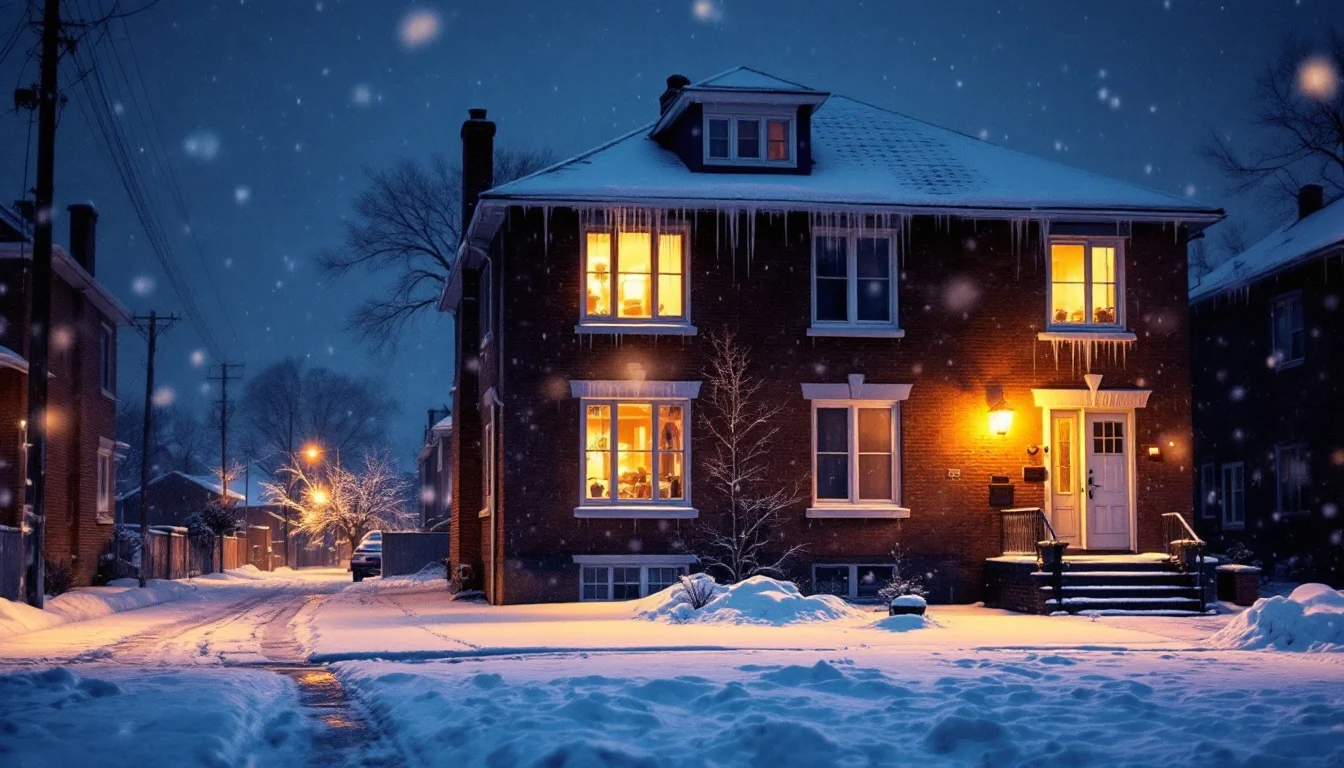
The first cold nights of October do something predictable in Montreal homes. Baseboards click on for the first time since April. There is a brief smell of dust burning off the elements. And somewhere in the basement, an electrical panel that spent the summer coasting starts working harder than it has all year.
Most of Quebec heats with electricity. That is why winter is the heaviest load your home’s electrical system will carry, by a wide margin. A system with a weak point usually reveals it in January, on the coldest night, when every circuit is drawing at once. October is when you can find that weak point first. Here is what to look at, in plain terms.
Heating load and panel capacity, explained
Your electrical panel has a fixed capacity, measured in amperes. Every circuit in the house shares it: lighting, appliances, the water heater and, once the cold arrives, the heating. Electric heat is by far the largest of these loads. Unlike a kettle or a dryer, it runs for hours at a time, in every room, for months.
Older Montreal homes were not built for this arithmetic. Many still run on their original service entrance, and some still have a fuse box. A home more than twenty years old very often lacks the wiring capacity that modern loads assume. Add an EV charger, a spa or a finished basement, and winter becomes the season when everything draws at the same time.
The honest way to answer “can my panel handle it” is a load calculation: an electrician adds up what the house can draw at once, heating included, and compares it to what the service entrance can deliver. If breakers trip when the heating and the stove run together, or the lights dim every time the heat kicks in, your panel is telling you it is near its limit. In that situation a panel upgrade is not a luxury. It is the fix.
The warning signs winter makes louder
Circuits run closer to capacity in winter, so weaknesses that hid all summer come out. Take these seriously:
- Breakers that trip repeatedly
- Lights that dim or flicker when the heating or another large appliance starts
- Sizzling or buzzing sounds from an outlet, a switch or the panel
- A burning smell you cannot place
- Outlets or switch plates that are discolored or warm to the touch
- Sparks when you plug something in
None of these are quirks of an old house. Each one is a connection failing under load. A breaker that will not hold is protecting you from something; the right response is to find out what, not to reset it a sixth time. The stakes are local and real: according to Statistics Canada, Montreal records the highest number of fires per year in Quebec, and 74.6% of them are residential.
Space heaters are a stopgap, not a heating system
Fire Prevention Canada reports that fire kills eight people each week in Canada, and that residential fires account for 73% of those deaths. Space heaters claim their share of that toll every winter. If you use one, use it on these terms:
- Keep it well away from curtains, beds and clothing. Coil-style heaters are especially dangerous near fabric.
- Plug it directly into a wall outlet, never into an extension cord or a power bar. Cords are meant for temporary use, and a heater is exactly the kind of sustained load that overheats them.
- Turn it off when you leave the room and when you sleep.
And one rule of thumb. If the same room needs a space heater every winter, the room does not have a heater problem, it has a heating problem. A baseboard or convector installed on its own circuit, with its own thermostat, solves it permanently and takes the fire risk out of the equation.
A fall checklist worth an hour of your time
- Turn on every heating zone now, before the deep cold. A dead baseboard in October is an annoyance. In January it is an emergency.
- Vacuum the dust out of baseboards and convectors. The burning smell on first start is dust, and it should pass within minutes. A smell that persists is not normal; shut the unit off and have it looked at.
- Check that each thermostat actually changes what its heater does. A unit that runs full blast regardless of the setting has a control problem, and it will show up on your Hydro-Québec bill.
- Look at the outlets winter will lean on: the block heater outlet, the one for holiday lights. Outdoors, a cracked cover or a loose-fitting plug becomes a real hazard.
- If your driveway or steps have snow-melting cables, have the controls checked before the first storm, not after it.
- If your wiring has never been inspected, book it. The standing recommendation is to have home wiring checked by an electrician every four years.
If something on this list gave you pause, a circuit that flickers, a panel you are not sure about, a room that never gets warm, that is exactly the work we do. Lighthouse Electrique has been a licensed master electrician in Montreal since 2007. Our electric heating service covers baseboards, convectors, radiant floors, bi-energy systems and snow-melting cables, and the emergency line is answered day and night. Call (514) 909-3773 and talk it through before the cold settles in.
Better to call early than too late.
24/7 Emergency Service: a firm price before any work starts.
Call (514) 909-3773 Request a callback