September 23, 2025 · 5 min read
Aluminum wiring in Montreal homes: why connections fail
Aluminum wiring is common in Montreal homes from the 1960s and 70s. Why connections fail, what Quebec insurers refuse, and what remediation involves.
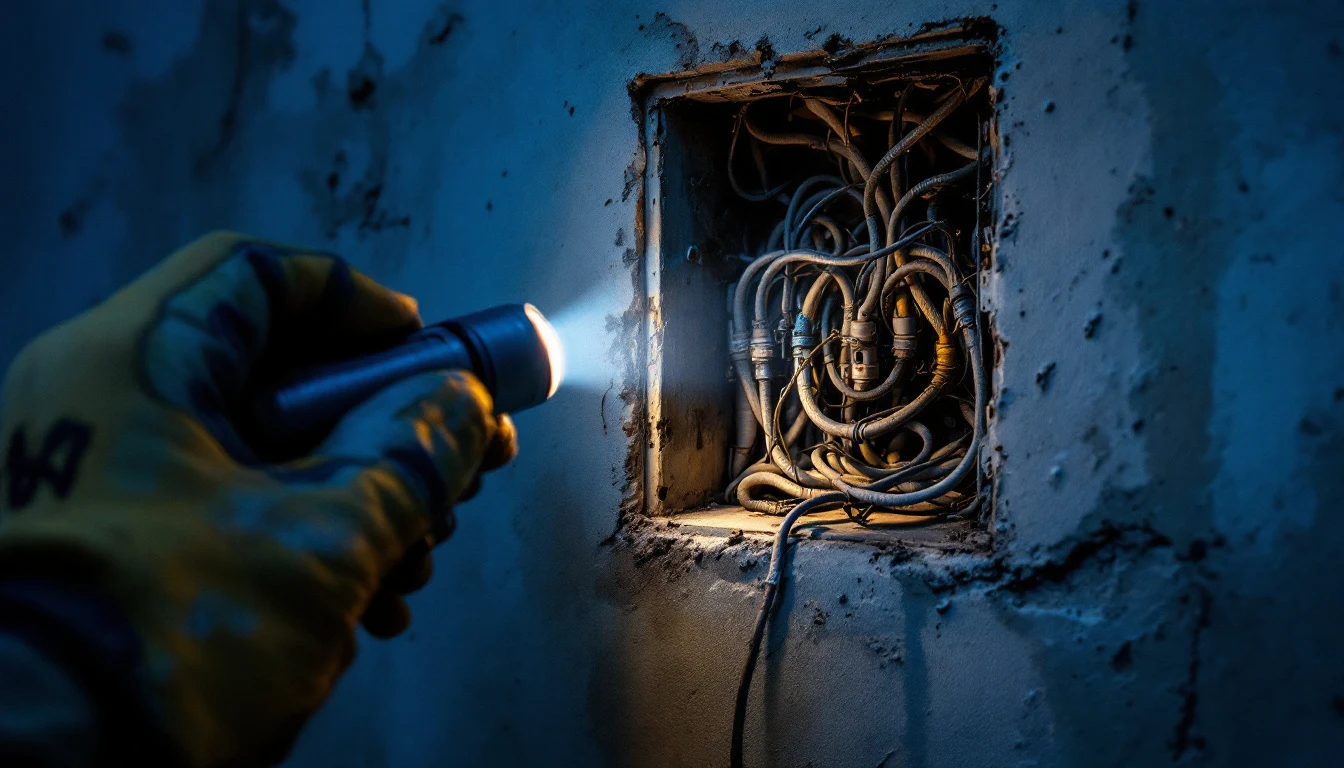
If your home went up between the mid 1960s and the late 1970s, there is a real chance the wiring behind your walls is aluminum, not copper. It was standard practice during the years when Montreal was building entire neighbourhoods: bungalows in Saint-Laurent, duplexes in Côte Saint-Luc and NDG, family homes across the West Island. Most owners learn about it one of two ways. A home inspector flags it during a sale, or an insurance renewal arrives with a question that was never there before: does this house have aluminum wiring?
September is the right month to take the question seriously. The first cool nights bring the baseboards back on, and circuits that idled all summer return to carrying real current. If a connection has loosened over the years, this is the season it starts to heat.
How aluminum wiring got into Montreal homes
Nobody cut a corner. In the mid 1960s the price of copper climbed sharply, and builders across North America switched to aluminum for branch wiring, the small-gauge wire that runs from the electrical panel to outlets, switches and lights. It was approved under the code of the day, it carried current perfectly well, and it went into new construction for roughly a decade before the industry moved back to copper.
One distinction matters before going further. The heavy stranded cable that feeds your panel from the street is often aluminum too, and that is still normal and accepted today. The concern in older homes is the small solid-conductor branch wiring. If your house was built in that window and has never been rewired, that is the wiring to ask about.
Why aluminum wiring connections fail
The wire itself is not the problem. The connections are. Three properties of aluminum work against it at every screw terminal in the house.
It expands and contracts more than copper. Every time a circuit warms under load and cools again, the wire moves slightly under the terminal screw. Copper does this too, but less.
It creeps. Aluminum slowly deforms under sustained pressure, so a connection that was tight in 1970 has relaxed over the decades. The screw does not back off. The metal underneath it flows.
Its oxide does not conduct. Copper oxide passes current reasonably well. Aluminum oxide is an insulator. Once a loose connection lets air reach the metal, a resistive film forms exactly where the current has to pass.
Put the three together and you get a slow spiral. A slightly loose joint runs slightly hot, the heat accelerates the loosening and the oxidation, resistance rises, and the joint runs hotter still. The end state is an arcing connection behind an outlet or switch, inches from framing lumber. One more failure mode is worth naming: renovation splices where copper was joined directly to aluminum. Dissimilar metals corrode at the junction, with the same result.
Warning signs of a failing connection
Aluminum wiring rarely announces itself. When it does, the signs are specific:
- a breaker that trips repeatedly with no obvious cause
- lights that flicker or dim when nothing changed on the circuit
- a sizzling or buzzing sound from an outlet or switch
- a smell of hot plastic near a device
- cover plates that are warm to the touch, or discoloured around the edges
Any of these deserves a call, not a shrug. If you smell burning or hear sizzling, cut power to that circuit at the panel first. The context makes the caution worth it: Montreal records more fires than any other city in Quebec, close to 75 per cent of them in residential buildings, and 22 per cent are attributed to an electrical malfunction, according to SPQ fire statistics.
What Quebec insurers refuse to cover
Insurers read the same fire data. Aluminum wiring now sits on a short list of things Quebec insurers have been refusing to cover, alongside fuse panels and circuits without grounding. Some decline the risk outright. Others will issue or renew a policy only once the wiring has been inspected and corrected by a licensed electrician, with a report to prove it.
The question tends to surface at the worst moments: a renewal notice, or the financing stage of a house purchase, when the deadline is real and the options feel narrow. It helps to know what the refusal actually means. The house is not uninsurable. The insurer wants the known failure points brought to a verifiable standard, and documentation that the work was done by someone licensed to do it.
What aluminum wiring remediation looks like
There are two honest paths, and the right one depends on the house.
Full rewiring replaces the aluminum branch circuits with copper. It is the definitive fix, and the most invasive one. It usually makes sense during a major renovation, when the walls are already open.
Connection correction is the standard remediation for an occupied home. An electrician opens every outlet, switch, fixture box and panel termination on the aluminum circuits, corrects each connection with connectors rated for aluminum, replaces devices with CO/ALR rated ones (a marking that means the device is approved for both copper and aluminum), and verifies the terminations at the panel. Done properly and documented, this is the work insurers accept.
One thing it is not: a weekend project. In Quebec, electrical work must legally be done by a licensed contractor, and aluminum raises the stakes, because a well-meaning copper splice installed with the wrong connector creates exactly the mixed-metal joint that fails.
If your home dates from that era, the useful next step is an assessment, not a guess. Lighthouse Electrique inspects and corrects aluminum wiring across Greater Montreal, with the documentation insurers ask for. Licensed master electrician, RBQ 8351-6120-43, since 2007. Read about the service on our aluminum wiring page, or call (514) 909-3773. A person answers, day or night.
Better to call early than too late.
24/7 Emergency Service: a firm price before any work starts.
Call (514) 909-3773 Request a callback