November 25, 2025 · 5 min read
Holiday lighting without tripped breakers in Montreal
Plan holiday lighting that will not trip a breaker: plain circuit math, extension cord rules and safe outdoor connections in the snow. Call (514) 909-3773.
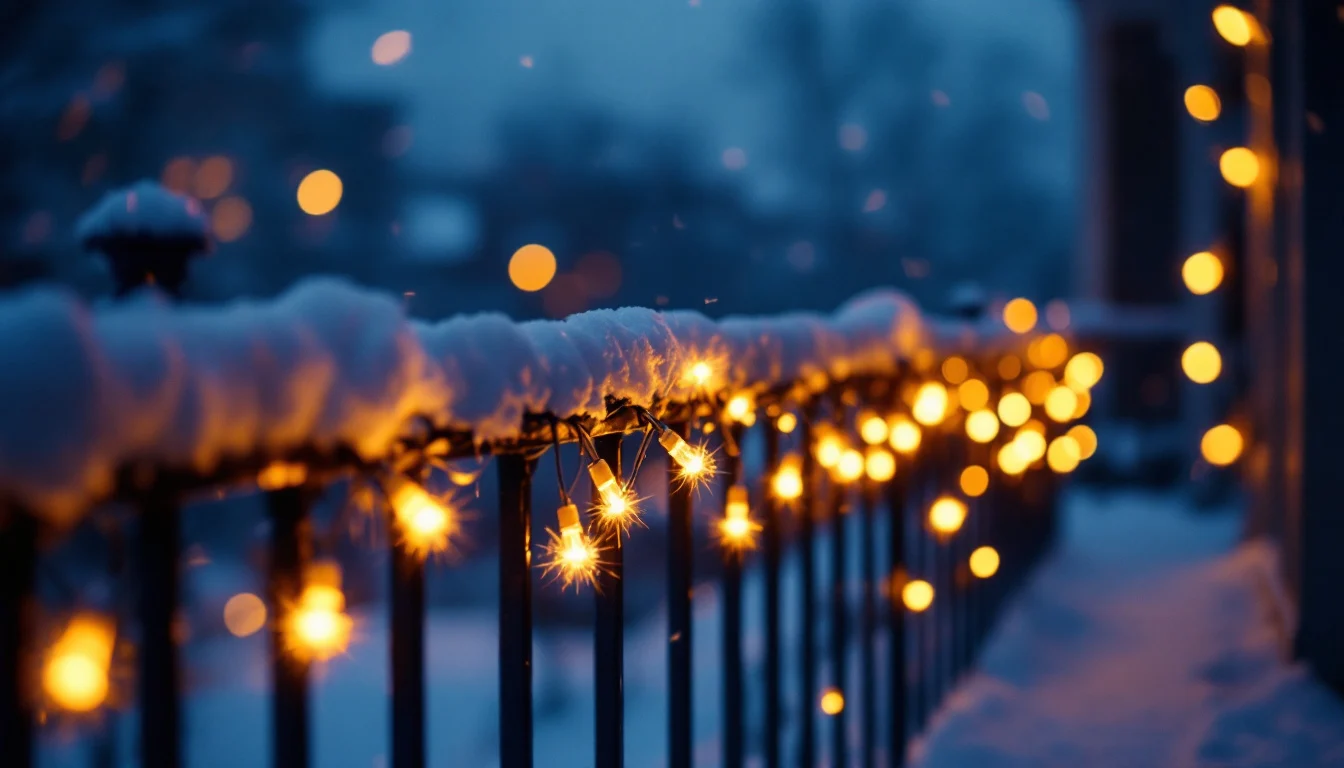
The first real snow is down, the bin of lights is out of the garage, and the plan for the balcony railing is ambitious. Then you plug in the third string, the outlet by the front door goes dead, and half the facade goes dark with it. Somewhere in the basement, a breaker has done exactly what it was built to do.
None of this is bad luck. A house that trips breakers in December is a house carrying a load nobody calculated. The good news: the calculation is short, and everything you need for it is printed on the boxes the lights came in.
Why holiday lights trip the breaker
A circuit breaker is a switch that watches current. Each circuit in your electrical panel is designed to carry a fixed amount of it, most often 15 amps in a Quebec home. When everything plugged into that circuit asks for more than the wiring can deliver safely, the breaker opens and cuts the power.
That is not a fault. It is the breaker protecting the wiring inside your walls from overheating. So when the lights go dark, the question is never what is wrong with the breaker. The question is what you asked that one circuit to feed.
How many lights can one circuit take
Three numbers do all the work.
- Volts. Household circuits in Quebec run at 120 volts.
- Amps. Most general-purpose circuits are protected at 15 amps.
- Watts. Multiply the two. 120 volts times 15 amps is 1800 watts.
A typical circuit can therefore carry about 1800 watts, and electricians keep a margin for anything that stays on for hours. Plan around 80 percent of capacity: roughly 1440 watts per circuit.
Now the practical part. Every light string, projector and inflatable sold today has its wattage printed on the packaging or on a tag near the plug. Add up everything you intend to plug into the same outlet, and into its neighbours, because several outlets usually share one circuit. Stay under the margin and the breaker will hold all winter.
Two things people forget:
- The circuit is not empty. The outlet at the front of the house may already feed the block heater, the garage, or the car shelter light. Those watts count too.
- Old incandescent strings draw many times the power of LED strings for the same glow. If the math is tight, retiring them is often the entire solution.
Extension cord rules for winter
Safety authorities are consistent on this point: an extension cord is a temporary measure, not permanent wiring. Brought out for a season and put away after, a good cord does its job. Left as the permanent power supply for anything, it is a problem waiting for a cold night.
For the weeks the cords are out:
- Outdoor cords only, with the jacket marked for outdoor use. Indoor cords are not built for cold or moisture.
- Match the cord to the run. A longer distance and a bigger load call for a heavier cord. A cord that feels warm under load is undersized. Replace it.
- One cord per run. Plugging cords into cords multiplies connections, and connections are where failures start.
- Uncoil it fully. A coiled cord under load traps its own heat.
- No pinch points. Never through a window, under a door, or beneath a mat where footsteps and ice grind down the insulation.
And the test of the word temporary: if the same cord runs to the same spot every December, that spot has earned a real outlet.
Outdoor connections in snow
Water and electricity cross paths constantly in a Montreal winter. The code has an answer for it: the GFCI outlet, short for ground fault circuit interrupter. It measures the current going out and the current coming back, and if some of it leaks, through moisture, through a damaged cord, through you, it cuts the power in a fraction of a second. Outdoor outlets are required to have this protection. If yours are old outlets with no test button, that is the first thing to fix.
The rest is about keeping connections dry:
- Keep every cord-to-cord connection off the ground and above the snow line, away from where shovels and snowblowers pass.
- Let the cord dip below each connection and rise back up, so melt water drips off at the bottom of the loop instead of following the cord into the plug.
- Use in-use covers on outdoor outlets, the deep covers that close even when a cord is plugged in.
- Outdoors, use only lights certified for outdoor use. Look for the certification mark on the tag.
- Unplug the string before changing a bulb or a fuse.
Signs the circuit is telling you to stop
Most circuits warn you politely before they fail. Take these seriously:
- A breaker that trips repeatedly on the same circuit
- Lights that flicker or dim when something else switches on
- A plug or outlet that is warm to the touch
- Buzzing or sizzling from an outlet or a connection
- Any smell of burning, however faint
A breaker that keeps tripping is protecting you from something. Do not replace it with a bigger one, and do not keep resetting it to see if it holds. Unplug the load and find the cause.
If the math says the front of your house needs more capacity, that is a solvable problem: an outdoor outlet where the cords currently run, a dedicated circuit for the seasonal load, or permanent outdoor lighting that retires the bin of cords entirely. Lighthouse Electrique has done this work across Greater Montreal since 2007. Call (514) 909-3773, describe what you want to light, and you will get a straight answer before anything is booked.
Better to call early than too late.
24/7 Emergency Service: a firm price before any work starts.
Call (514) 909-3773 Request a callback